Here’s where 3D printing for healthcare can make the biggest difference, and how to make sure you get the best results.
If you’re developing a medical device or planning complex procedures, you’ll know how quickly time, cost, and compliance pressures can build. Having to wait weeks for prototypes or relying on standardised solutions can drastically slow down your progress and add unnecessary cost, too.
3D printing for healthcare gives you a faster, more flexible way forward. From rapid prototyping and surgical planning models to customised medical devices and anatomical replicas, 3D printing is helping hospitals, dental labs, medical device manufacturers, and orthopaedic teams streamline their workflows and bring innovative products to market faster.
But the value doesn’t come from the printer alone. It comes from choosing the right technology, material, and workflow for your application. Here’s where 3D printing for healthcare can make the biggest difference, and how to make sure you get the best results.
Key applications of 3D printing in healthcare
Healthcare is built around individual needs. Every patient is different, every procedure has its own challenges, and every device needs to be tested, refined, and validated before it can move forward. This is where additive manufacturing delivers the biggest benefits:
Faster medical device prototyping
Every design iteration matters when you’re developing a medical device. You need to test form, fit, and function, gather clinical feedback, refine the design, and move towards validation without losing momentum.
Traditional prototyping makes that process slow and expensive. With 3D printing, you can produce prototypes faster and test them earlier. Your team can assess ergonomics, review device geometry, and understand how a product interacts with anatomical structures before committing to the next stage. That means you can spot any issues sooner and reduce the risk of costly changes later down the line.
Patient-specific anatomical models and surgical planning
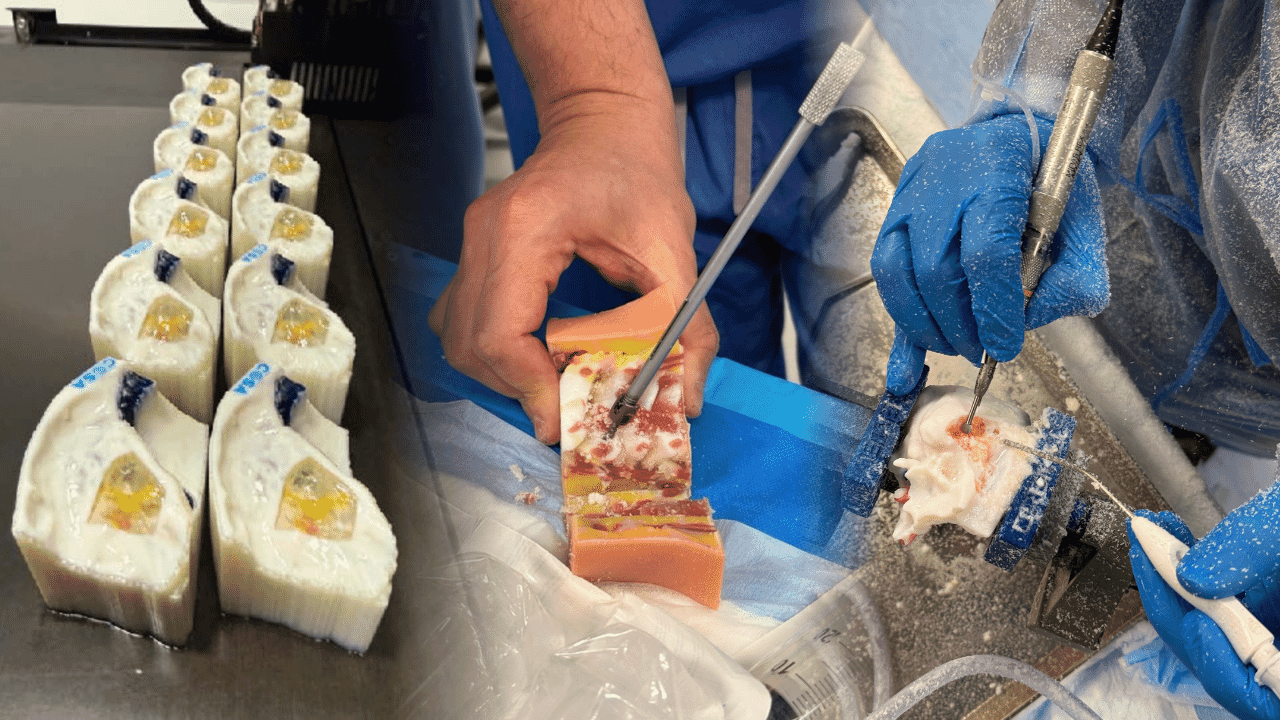
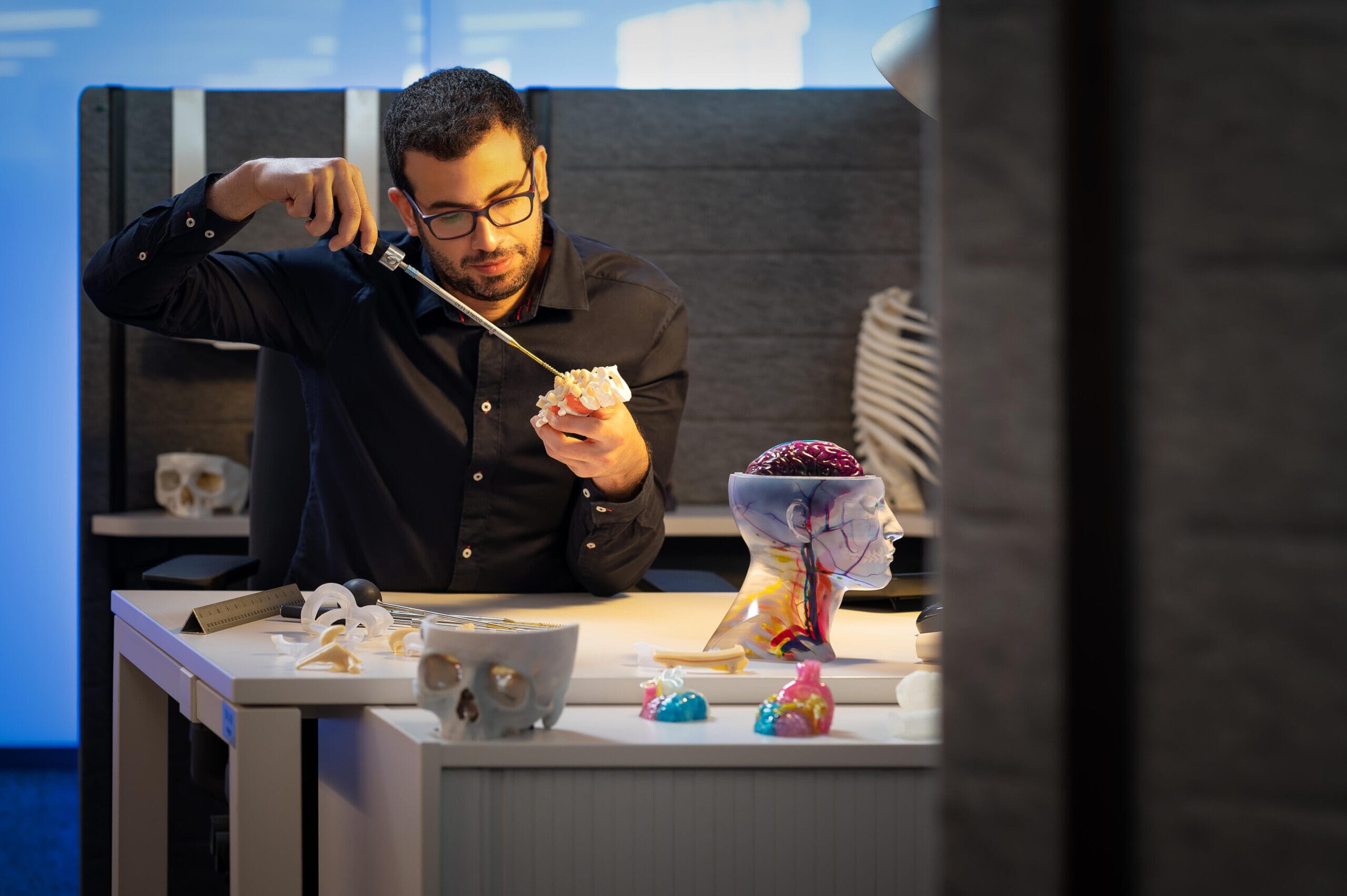
If you’re planning a complex procedure, a flat image can only take you so far. 3D printing allows you to produce patient-specific anatomical models from scan data, giving your clinical team a physical model they can hold, review, and use before entering theatre.
That can make a huge difference to surgical planning. Your teams can better understand complex anatomy, align around the procedure, and communicate the procedure more clearly with patients. Instead of explaining a treatment plan from a screen alone, you can use a model that reflects the patient’s actual anatomy.
Better training, testing, and collaboration
Does your team rely on 2D imaging, cadavers, or animal models for training and evaluation? These methods can be valuable, but they’re not always easy to access and can produce inconsistent results. And not to mention, they’re expensive.
3D printed anatomical models give you a practical way to train your staff, test new devices, and prepare for procedures before you begin working with patients. Instead of relying on scans, you can use physical models that accurately represent patient anatomy, so your clinicians can practice different techniques and evaluate device performance before it’s used in a clinical setting.
How to get the best results for your healthcare application
Once you know where 3D printing could support your medical, dental, or clinical workflow, the next step is to choose the right setup. Here’s what you need to consider:
Choose the right 3D printer
When choosing a 3D printer, start with the part. What do you need to produce? How will it be used? Does it need visual realism, biocompatibility, strength, heat resistance, or sterilisation compatibility? Once you know that, it becomes much easier to choose the right system.
| Application | Recommended printer | Ideal for |
| Medical modelling, surgical planning, and dental applications | Stratasys J5 MediJet | Hospitals, surgical teams, dental labs, and medical education |
| Anatomical training, device testing, and procedural development | Stratasys J5 Digital Anatomy or J850 Digital Anatomy Printer | Clinical training, medical device manufacturers, and training institutions |
| Functional parts, tooling, and medical device development | Stratasys FDM Systems | Medical device manufacturers, R&D teams, and production environments |
Match the technology to your application
Different 3D printing technologies solve different problems. Choosing the right one will help you get the performance you need, without investing in capability you won’t use. Here’s how each technology compares:
| Technology | Best for | Typical applications |
| PolyJet | Visual models that require high levels of detail and realism | Surgical planning models, medical education, dental models, patient communication, and device demonstrations |
| Digital Anatomy | Anatomical models that need to replicate the look and feel of human tissue and bone | Clinical training, device testing, procedural planning, and medical education |
| FDM | Functional parts that require strength and durability | Medical device development, production support, tooling, fixtures, and laboratory workflows |
Select materials that meet your demands
The finish step is to make sure the material matches the demands of your application. The material you choose will affect how the part performs, whether it’s suitable for patient contact, how it can be handled, and whether it can withstand the conditions of its intended use.
| Material | Best suited for | Key benefits |
| Biocompatible PolyJet materials (MED610, MED625FLX, and MED620) | Surgical guides and medical devices that require patient contact | High accuracy, excellent detail, and suitability for specific patient-contact applications |
| TrueDent | Dental applications and digital dental workflows | Produces realistic, full-colour dental applications, reduces labour time, and improves laboratory efficiency |
| ULTEM 1010 | Functional medical applications, custom medical devices, and autoclave-sterilisable parts | Excellent strength, thermal stability, and durability for demanding healthcare environments |
Harness the power of 3D printing for healthcare with Tri-Tech 3D
3D printing for healthcare can help you move faster, reduce development barriers, and create solutions that are better suited to real clinical and medical device applications. But getting there starts with choosing the right system.
At Tri-Tech 3D, we help healthcare organisations, dental labs, and medical device manufacturers across the country to identify the right 3D printing technology for their workflow. As the UK’s leading distributor and supplier of Stratasys and One Click Metal 3D printing systems, we offer an impressive range of printers for complex medical, dental, and clinical applications, supported by a full range of advanced materials and expert technical support.
Not sure where to start? Our 3D printing experts are always on-hand to help you choose the right printer, technology, and material for your application. Whether you’re looking to accelerate medical device development or streamline dental production, we’ll help you build a workflow that delivers genuine value.
Contact us to discover how 3D printing could benefit your healthcare workflow.
FAQs
What is 3D printing used for in healthcare?
3D printing for healthcare is used for a wide range of applications, including medical device prototyping, patient-specific anatomical models, surgical planning, surgical guides, dental appliances, orthotics, prosthetics, training models, and functional medical components.
How can 3D printing improve medical device development?
3D printing allows medical device teams to create, test, and refine prototypes much faster than traditional manufacturing methods. This helps you assess fit, form, function, and usability earlier in development, gather feedback sooner, and reduce the risk of costly changes later on.
What materials are used for medical 3D printing in the UK?
Common material options for medical 3D printing include biocompatible PolyJet materials for surgical guides, dental models, and patient-contact applications, TrueDent for dental workflows, and high-performance thermoplastics such as ULTEM 1010 for functional medical parts and autoclave-sterilisable applications.
How do I choose the right 3D printer for my healthcare application?
Start with the part you need to produce. Consider how it will be used, whether it needs to be biocompatible, how much detail or realism is required, and whether it needs strength, heat resistance, or sterilisation compatibility. From there, you can match the application to the right printer, technology, and material.
New to 3D
Printing or looking
for some support?
- Call: 01782 814551
- Email: info@tritech3d.co.uk