How COSA Ltd is advancing surgical simulation and medical device development with the Stratasys J850 Digital Anatomy Printer.
New medical devices, implants and gene therapies must go through rigorous testing before they can be safely used with patients. Each procedure needs to be carefully validated and refined to ensure it performs as intended. Traditionally, this testing has relied on cadaver tissue or animal specimens, but these methods can be difficult to source, often costly and unable to fully replicate real patient conditions. As personalised medicine and minimally invasive surgery continues to advance, the demand is growing for realistic, reliable and repeatable surgical models.
Cambridge-based med-tech company COSA Ltd is helping to meet this need. Combining advanced engineering with additive manufacturing to create patient-specific anatomical models, COSA gives researchers, surgeons and device manufacturers the opportunity to trial new procedures and refine devices long before they reach clinical practice.
Recently, at the centre of this work is the Stratasys J850 Digital Anatomy Printer, recommended and supplied by the team at Tri-Tech 3D, it allows COSA to produce models that don’t just look like human tissue, but behave like it too.
About COSA
COSA was founded in Cambridge in 2023. The company supports the development of complex medical devices, cell and gene therapies through advanced anatomical modelling, working closely with pharmaceutical companies, device manufacturers and clinicians. Together, they test and validate new treatments in a controlled setting before they ever reach a patient.
COSA started out in ENT (Ear, Nose and Throat), working closely with specialist surgeons, and has since expanded into neurosurgery, sinus surgery and beyond, now offering a full research and development service, covering imaging, digital modelling, material development & validation, and follow-up data for further R&D.
The Challenge
An anatomically accurate model is often only half the job, for surgical simulation to be useful, it also has to behave like real human tissue. Surgeons need to feel genuine resistance when drilling through bone, or to notice change in tissues as they work.
Before investing in the J850, COSA relied on conventional resin-based printing. The results were detailed, and still work for a handful of clients, but building realistic multi-material models meant assembling separate parts by hand, working around the limits of single-material printing. As projects became more complex, this approach couldn’t be the only offering.
“We needed a multi-material, high-resolution printer capable of replicating the biomechanical behaviour of soft tissue,” says Dr Filip Hrnčiřík, Co-founder and CEO of COSA. “At the time, the J850 was the only system on the market that offered the anatomical fidelity and mechanical realism we were looking for.”
Why the Stratasys J850?
COSA needed more than good print quality. It needed a platform that could reproduce the mechanical properties of anatomy, not just how it looked. After discussions and recommendations from Medical Additive Manufacturing Specialist, Silvana Arteaga Moreno, at Tri-Tech 3D, the team chose the Stratasys J850 for its high-resolution PolyJet printing and digital anatomy capabilities, which can combine multiple materials, each with different stiffness, flexibility, transparency and colour, all within a single build.
Just as important was Stratasys GrabCAD Anatomical Creator, allowing COSA to move beyond preset materials and develop its own ‘recipes’.
“That was one of the biggest advantages for us,” Hrnčiřík explains. “Instead of relying on predefined settings, we can validate our own material combinations against cadaver and biological tissues, refining them until they replicate the behaviour we’re after.”
Bringing Complex Anatomy to Life
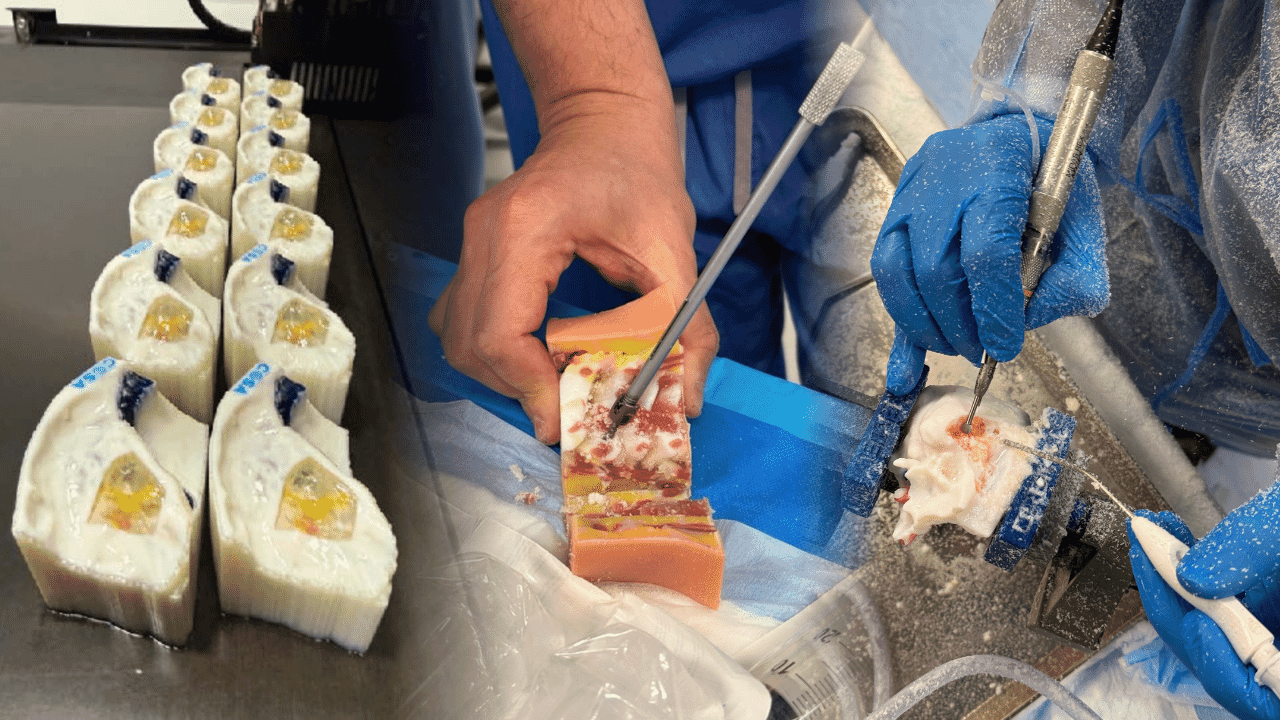
The J850 now supports a growing portfolio of surgical simulation, device development and therapy projects. One of the most notable is a drillable temporal bone model for ENT surgery. Built from high-resolution micro-CT scans, it was validated with experienced surgeons to match the real thing, right down to how it feels during cochlear implant access.
COSA has since developed realistic brain models, along with work supporting sinus surgery, neurosurgical research and cancer studies. One project involved building an anatomically accurate mouse tumour model for a cancer research device. Due to their repeatability and measurability, researchers can use them to evaluate device performance without relying solely on live specimens.
“Our goal isn’t just to produce a model,” says Dr Iwan Vaughan Roberts, Co-founder & Chief Scientist of COSA. “It’s to create a platform that lets researchers and clinicians generate meaningful data and de-risk innovation.”
Engineering Realism Through Materials
That realism comes down to careful material selection. COSA has taken full advantage of the Stratasys Agilus™ material family, combining colour, texture and flexibility within a single model so surgeons can clearly identify different structures. Pairing Agilus™ with GelMatrix™ material, adds varying density, while rigid structures, such as bone, are produced using Vero™ or BoneMatrix ™ materials, all together, creating an accurate tactile model.
“The direction you cut through tissue changes how it feels,” Roberts explains. “Developing our own material combinations lets us recreate that tactile feedback in a way conventional 3D printing simply can’t.”
More Than a Printed Model
The printer is only part of the story. COSA’s real value lies in the expertise the team has built around it. Rather than working as a print bureau, they develop bespoke programmes with pharmaceutical companies, device manufacturers and research organisations. Some projects last a few weeks, whist others run for several years.
“We’ve built a full R&D service around what the technology enables,” says Hrnčiřík. “The models are just one part of that, but the real value comes from the data and insight they generate.” The team is now integrating sensors into its models too, capturing quantitative data during simulated procedures rather than relying on assumption.
A Collaborative Partnership with Tri-Tech 3D
COSA was one of the first organisations in the UK to invest in the J850. That meant finding a technology partner it could work closely with, from installation through to ongoing support. “We’ve been very happy with the support from Tri-Tech 3D,” Roberts says. “Paul Webber, (Engineering Director at Tri-Tech 3D) has been incredibly knowledgeable and proactive, regularly checking in to make sure everything’s running as it should.”
Because it was one of the UK’s first Digital Anatomy systems, there were a few things to work through early on. Working with the teams at Tri-Tech & Stratasys, these were resolved quickly. “The relationship has always been collaborative,” Hrnčiřík adds. “Tri-Tech 3D were open, responsive and committed to helping us get the very best from the system.”
Looking Ahead
Although COSA’s expertise began in ENT, its ambitions reach much further. The long-term goal is anatomically and biomechanically realistic models for virtually any area of medicine, built from a growing database of validated materials and geometries.
“Our ambition is to reach the point where we can produce any anatomy with realistic material properties,” says Hrnčiřík. “If a surgeon wants to rehearse a procedure on a patient-specific model that behaves like the real thing, and requires the follow-up data that we can provide, that’s where we’re heading.”
Discover More
COSA Ltd is demonstrating how advanced 3D printing technology can help transform the way medical devices, surgical procedures and therapies are developed, tested and validated. By combining patient-specific anatomical modelling, material science and data-driven insights, COSA is helping researchers, clinicians and manufacturers reduce risk and accelerate innovation before treatments reach the patient.
To learn more about COSA’s work in developing realistic anatomical models for medical research, device development and surgical simulation, visit their website: www.cosaltd.com
New to 3D
Printing or looking
for some support?
- Call: 01782 814551
- Email: info@tritech3d.co.uk