
A New Generation of Industrial 3D Printing for High-Volume Production
Stratasys H550 released at Formnext 2026
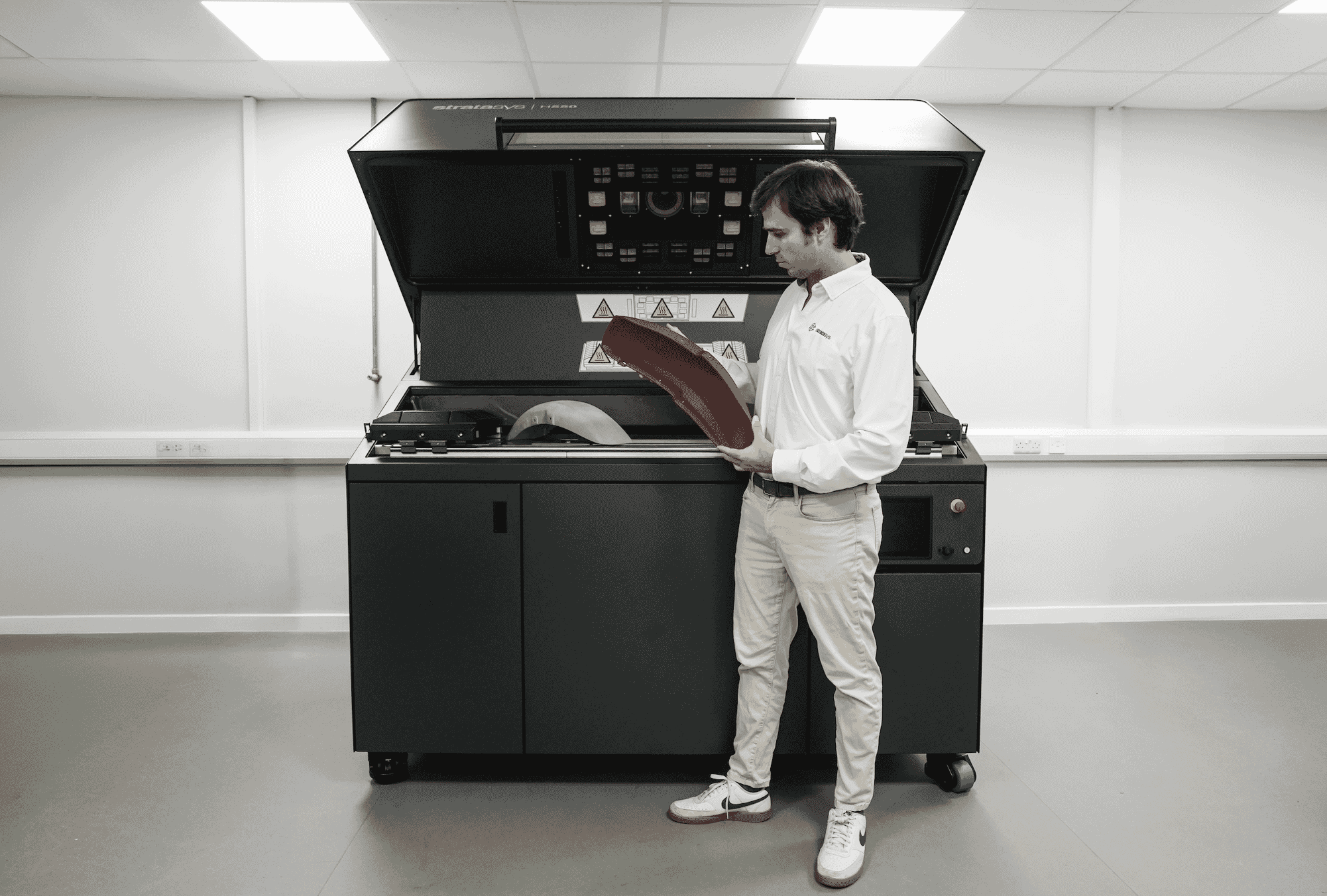
Stratasys has unveiled the new H550 industrial 3D printer, expanding its Selective Absorption Fusion (SAF) technology with a larger build volume, increased production capacity and the potential for lower cost per part. But what makes the H550 different, who is it designed for, and how could it change industrial 3D printing?
Industrial 3D printing continues to evolve, with manufacturers increasingly looking beyond prototyping and towards the production of functional, end-use components.
The latest development comes from Stratasys, which officially unveiled its new Stratasys H550 SAF 3D printer at Formnext 2026.
Designed to help manufacturers scale additive manufacturing, the H550 introduces a 34.2-litre build volume, a 450mm build axis and an automated powder handling workflow. It is aimed at businesses looking to manufacture larger components, produce more parts per build and improve the economics of industrial 3D printing.
Adrian Painter, Managing Director at Tri-Tech 3D commented:
“The Stratasys H550 represents an exciting step forward in industrial polymer 3D printing, combining a significantly larger build capacity, increased productivity and lower cost per component. Its enhanced automation and production efficiency make it an attractive proposition for manufacturers looking to move beyond prototyping and embrace additive manufacturing as a viable, scalable production process.”
With Stratasys claiming up to 30% lower total cost of ownership compared with comparable print-and-fuse systems, the H550 is an interesting new addition to the industrial polymer 3D printing market.
What is the Stratasys H550?
The Stratasys H550 is an industrial polymer powder bed fusion 3D printer powered by Selective Absorption Fusion (SAF) technology.
It has been developed for manufacturers who want to move beyond prototyping and use 3D printing for repeatable, higher-volume production of functional end-use parts.
SAF works by selectively applying a high-absorption fluid to polymer powder. Infrared energy is then used to fuse the treated powder particles together, building components layer by layer.
Unlike traditional FDM 3D printing, which deposits material through a nozzle, SAF builds components within a powder bed. This allows multiple parts to be manufactured simultaneously, including complex geometries that would be difficult or expensive to produce using conventional manufacturing methods.
The H550 builds on Stratasys’ existing H350 SAF platform, offering a significantly larger build capacity and greater flexibility for producing larger components.
Stratasys H550: Key specifications
Some of the key specifications and features of the Stratasys H550 include:
- Technology: Selective Absorption Fusion (SAF).
- Build volume: 34.2 litres.
- Build dimensions: 365 × 208 × 450mm.
- Maximum build axis: 450mm.
- Layer thickness: 100 microns.
- Parts per build: More than twice the capacity of the H350.
- Throughput: Up to 50% higher than the H350.
- Post-processing: PowderEase T2 automated powder handling.
- Materials: Qualified SAF materials including SAF PA12.
The increased build capacity is one of the most significant developments, providing manufacturers with the opportunity to produce larger individual components or increase the number of smaller parts manufactured in a single build.
Who is the Stratasys H550 suited to?
The Stratasys H550 is primarily designed for manufacturers looking to scale industrial 3D printing and bring more production work in-house.
It will be particularly relevant to businesses where production volume, repeatability, part size and cost per component are important considerations.
The H550 is particularly suited to:
- Manufacturers producing functional end-use components.
- Automotive businesses manufacturing ducts, manifolds, housings and tooling.
- Aerospace and UAV manufacturers requiring lightweight, complex components.
- Robotics companies producing end-of-arm tooling and robotic components.
- Medical manufacturers producing customised devices and equipment.
- Orthotics and prosthetics manufacturers.
- 3D printing service bureaus looking to increase production capacity.
- Existing Stratasys H350 users looking to manufacture larger parts and increase throughput.
For businesses already using powder bed fusion technology, the H550 offers another option for increasing production capacity without necessarily moving towards a completely different manufacturing process.
It is also worth considering for manufacturers currently using traditional production methods. Where components are complex, produced in relatively low volumes or require expensive tooling, additive manufacturing can offer greater design flexibility and potentially reduce manufacturing costs.
Key applications of the Stratasys H550
One of the biggest advantages of the H550 is its ability to accommodate larger components while still offering the high packing efficiency needed for batch production.
Stratasys has highlighted several industries and applications where the additional build capacity could make a difference.
1. Automotive manufacturing
The H550’s 450mm build axis opens up opportunities for producing larger automotive components, including:
- Air ducts and ventilation systems.
- Manifolds.
- Functional housings and enclosures.
- Brackets and mounting components.
- Production tooling and fixtures.
The ability to manufacture complex geometries without traditional tooling can help automotive manufacturers reduce assembly complexity and consolidate multiple components into a single printed part.
2. Aerospace, drones and UAV components
Lightweight, complex components are particularly important in the aerospace and unmanned aerial vehicle (UAV) sectors.
The H550 can be used to manufacture components such as:
- Drone housings and structures.
- Lightweight brackets.
- Ducting and airflow components.
- Functional enclosures.
- Complex integrated assemblies.
The larger build envelope provides greater flexibility when manufacturing longer components that may not fit within smaller industrial powder bed fusion systems.
3. Robotics and end-of-arm tooling
Robotics manufacturers can benefit from the ability to produce bespoke tooling and functional components without the cost and lead times associated with conventional tooling.
Potential applications include:
- Robotic grippers.
- End-of-arm tooling.
- Lightweight robotic components.
- Bespoke mounting systems.
- Custom fixtures and assembly aids.
By using additive manufacturing, engineers can optimise component geometry, reduce unnecessary material and incorporate features directly into the design.
4. Medical devices, orthotics and prosthetics
The ability to produce customised components makes powder bed fusion particularly interesting for medical applications.
Potential uses include:
- Orthotic devices.
- Prosthetic components and sockets.
- Patient-specific supports.
- Functional medical housings.
- Customised equipment.
The H550’s increased build capacity could allow manufacturers to produce larger devices or batch multiple customised components together.
Material suitability, regulatory requirements and application-specific validation remain important considerations for medical production.
5. Industrial manufacturing and production tooling
For general manufacturers, the H550 offers opportunities to produce functional components and manufacturing aids directly from digital designs.
Applications include:
- Jigs and fixtures.
- Assembly tooling.
- Machine guards and covers.
- Functional housings.
- Ducting and manifolds.
- Bespoke production components.
This can help businesses reduce reliance on traditional tooling, shorten lead times and respond more quickly to changing production requirements.
What makes the Stratasys H550 different from other industrial 3D printers?
The industrial polymer 3D printing market already includes established technologies such as HP Multi Jet Fusion (MJF) and Selective Laser Sintering (SLS).
So what makes the H550 stand out?
There are four key areas where Stratasys is positioning the new system differently.
1. A larger build capacity and 450mm build axis
The H550 offers a 34.2-litre build volume and a 450mm build axis.
Stratasys states that its long axis is 20% longer than the leading comparable print-and-fuse system, allowing manufacturers to produce larger individual components without splitting designs into multiple sections.
For businesses manufacturing long ducts, manifolds, housings and other functional components, this additional space could be a major advantage.
It also provides more flexibility when nesting multiple components together in a single build.
2. Designed to reduce cost per part
One of Stratasys’ biggest claims for the H550 is its potential to reduce the cost of industrial 3D printing.
The H550 is designed to deliver up to 30% lower total cost of ownership compared with comparable print-and-fuse systems.
Several factors contribute to this claim:
- Increased build capacity.
- More parts produced per build.
- Efficient powder utilisation.
- Reduced consumable requirements.
- Automated powder handling.
- Reduced operator intervention.
For businesses producing hundreds or thousands of components, even relatively small improvements in cost per part can have a significant impact on overall production economics.
Actual savings will depend on part geometry, material usage, build utilisation, production volume and operating costs.
3. PowderEase T2: Automated powder handling
Another important part of the H550 launch is the introduction of the Stratasys PowderEase T2.
Powder handling is an important consideration with industrial powder bed fusion systems. Once a build has finished, printed components need to be separated from the surrounding powder, with reusable material recovered, sieved and prepared for future builds.
The PowderEase T2 automates several of these processes:
- Part breakout.
- Powder retrieval.
- Powder sieving.
- Material dosing.
Stratasys states that the system can support up to six H550 printers from a single station when using the same material.
The complete production workflow requires less than 30 minutes of total operator time per build.
This is particularly important for manufacturers looking to increase production volumes. Reducing manual powder handling can help streamline operations, minimise operator intervention and make it easier to scale a production environment.
4. Production speed and repeatability
The H550 has been designed around the demands of production manufacturing rather than simply producing individual prototypes.
SAF technology uses a thermal powder bed fusion process in which build time is not directly dependent on the number of parts packed into the build.
This means manufacturers can potentially increase the number of components produced without proportionally increasing printing time.
Stratasys also highlights the H550’s ability to deliver up to 50% higher throughput than the H350, alongside more than twice the parts per build.
Combined with automated powder handling, this creates a production-focused system designed to help manufacturers increase output while maintaining consistent manufacturing processes.
Stratasys H550 vs H350: What’s the difference?
The H550 is designed to complement the existing Stratasys H350 rather than simply replace it.
Both machines use SAF technology, but the H550 offers a larger build envelope and greater production capacity.
Some of the key differences include:
Build volume: The H550 offers a 34.2-litre build volume compared with 19 litres on the H350, representing an increase of almost 80%.
Build dimensions: The H550 has build dimensions of 365 × 208 × 450mm, compared with 315 × 208 × 293mm on the H350.
Parts per build: The H550 can accommodate more than twice the number of parts per build compared with the H350, depending on component geometry and build configuration.
Throughput: Stratasys states that the H550 offers up to 50% higher throughput than the H350.
Applications: The H350 is suited to small and medium-sized production components, while the H550 is designed to accommodate larger individual parts and higher-volume production requirements.
For existing H350 users, the H550 provides a route to expanding production capacity and taking on applications that require larger individual components.
The two systems can also share the PowderEase T2 workflow when processing the same material, helping manufacturers integrate additional capacity into an existing SAF production environment.
When was the Stratasys H550 released?
Stratasys officially unveiled the H550 at Formnext 2026 in Frankfurt, Germany, on 17 November 2026.
Tri-Tech 3D Marketing Manager Catherine Hackwood was there for the live reveal:
“The excitement around the stand during the reveal was fantastic! Our customers have been asking for a larger build size for some time, and Stratasys has delivered. I’m confident this new system will make it much easier for customers to bridge the gap between prototyping and production, opening up even more opportunities for them.”
The announcement also introduced the PowderEase T2 automated powder handling system.
Pre-orders opened on 17 November 2026, with commercial availability planned for Q2 2027.
Find out more about the Stratasys H550
Interested in finding out how the new Stratasys H550 could support your manufacturing requirements?
Our team can help you understand the capabilities of SAF technology, identify suitable applications and assess whether the H550 is the right solution for your production environment.
Get in touch to discuss the Stratasys H550, request further information or explore how industrial 3D printing could benefit your business.