How stereolithography reduced master pattern lead times by 70%, saved up to 150 hours of manual labour and improved consistency for a historic UK foundry.
At a glance
Customer: G.W. LUNT
Industry: Architectural metalwork and heritage restoration
Application: Investment casting master patterns
Technology: Stratasys Neo® stereolithography 3D printer
Material: Somos® WaterShed® AF resin
Key results:
- Reduced master pattern lead times by approximately 70%
- Saved 120–150 hours of manual labour per pattern
- Reduced scrap and rework by an estimated 20%
- Improved dimensional consistency across metal and stone components
- Reduced production timelines by up to nine weeks
The Challenge: Reducing lead times without compromising traditional craftsmanship
Founded in Birmingham’s Jewellery Quarter in 1930, G.W. LUNT is one of the UK’s longest-established continuously operating foundries. With expertise spanning architectural metalwork, sculpture and heritage restoration, the company combines traditional foundry skills with an ambition to embrace more modern manufacturing methods.
Following the acquisition of the business in 2018, Managing Director Jake Solomon began exploring opportunities to modernise production while preserving the craftsmanship at the heart of the foundry.
One particular challenge was the production of master patterns for investment casting. Traditionally, this involves several labour-intensive stages, including manual sculpting, rubber mould creation and wax pattern preparation, all before the casting process can begin.
For complex architectural projects, these stages can introduce lengthy lead times, additional handling and opportunities for dimensional variation. Coordinating designs across different trades and materials also adds complexity, particularly where cast metal components need to fit precisely alongside stonework.
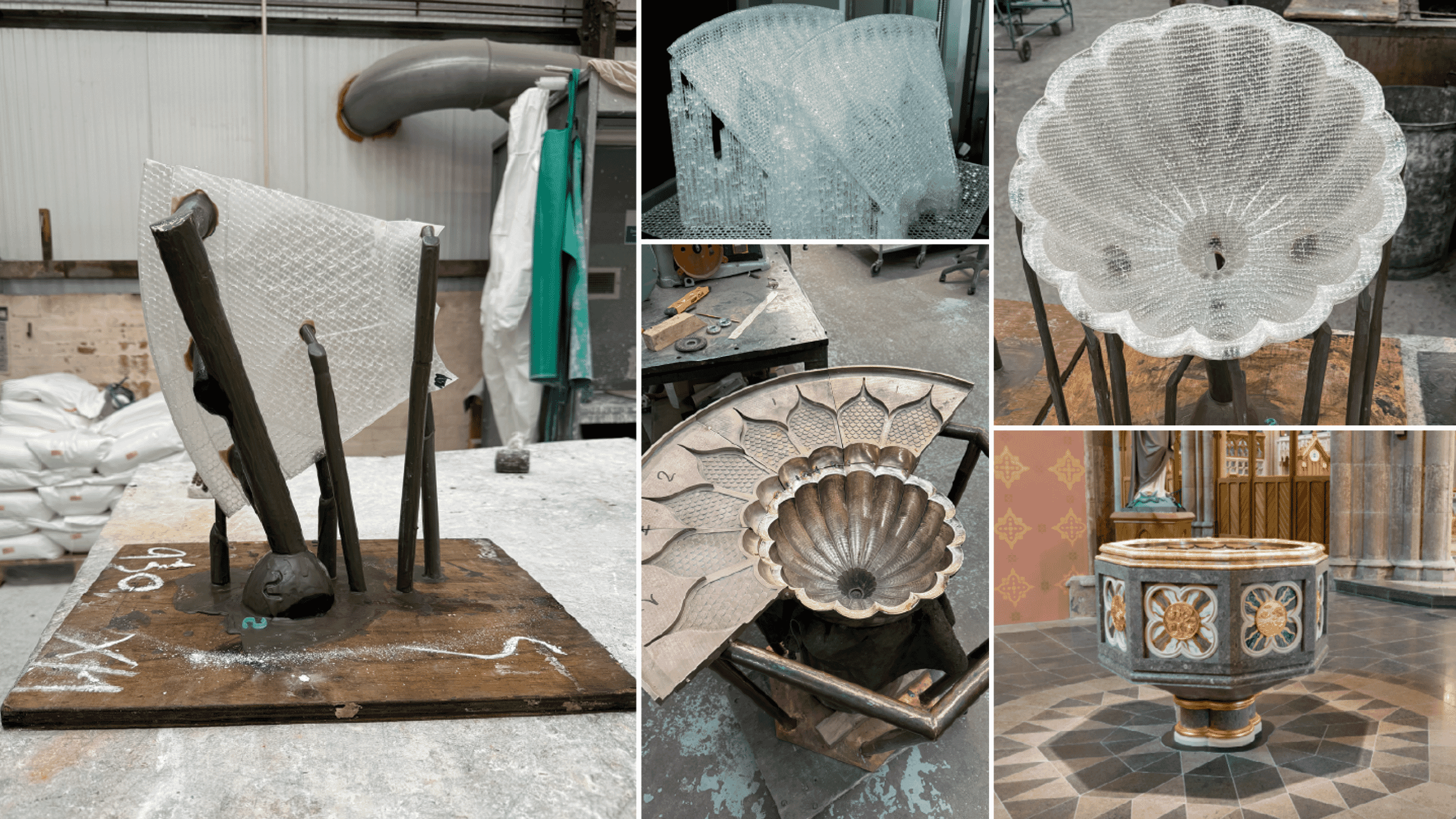
On a recent cathedral project involving a new bronze font, altar and ambo, dimensional accuracy was essential. The traditional patternmaking process alone could take around 12 weeks and require approximately 150 hours of manual labour.
Having previously experimented with resin-based 3D printing without success, G.W. LUNT was initially cautious about revisiting the technology. However, the potential to simplify pattern production, improve accuracy and reduce lead times made it an opportunity worth exploring.
The Solution: Bringing additive manufacturing into the casting process
Working alongside Stratasys and introduced to the technology by Tri-Tech 3D, G.W. LUNT adopted the Stratasys Neo® stereolithography 3D printer, using Somos® WaterShed® AF resin to produce investment casting master patterns.
Designed for investment casting applications, WaterShed AF offered the clean burnout characteristics needed to overcome issues experienced with previous resin systems.
The move to stereolithography also replaced several traditional patternmaking stages with a more direct digital workflow. Rather than manually sculpting patterns, creating rubber moulds and preparing wax patterns, the team could produce master patterns directly from digital designs.
Working collaboratively during design preparation, G.W. LUNT and the wider project team were able to develop and refine drawings in real time, identifying potential issues before committing to production.
The digital models also made it easier to communicate designs with the customer and other trades involved in the project. Instead of relying solely on 2D drawings, everyone could visualise the finished components and understand how they would fit together.
This was particularly important for the cathedral project, where the bronze components needed to align accurately with the surrounding stonework.
Printing took approximately 30–40 hours, with the overall process completed in around three weeks.
As Jake Solomon, Managing Director at G.W. LUNT, explains:
“We didn’t have to do any work on the printed patterns. They came through exactly as needed. It was remarkably easy to integrate them back into our traditional casting process.”
The Results: Faster production, less rework and greater accuracy
The introduction of stereolithography delivered significant improvements to G.W. LUNT’s patternmaking process, without replacing the traditional casting expertise that defines its business.
70% reduction in lead times
What would traditionally have taken around 12 weeks was completed in approximately three weeks, reducing master pattern production time by around 70%.
120–150 hours of manual labour saved
By removing several manual preparation stages, the team significantly reduced the time required to produce each master pattern, freeing up skilled resource for other areas of production.
20% less scrap and rework
The improved consistency of printed patterns helped reduce dimensional variation and issues associated with wax deformation, with G.W. LUNT estimating an approximately 20% reduction in scrap and rework.
Improved dimensional accuracy
The digital workflow helped maintain greater consistency between the original CAD designs and finished cast components. This was particularly valuable when bringing together metal and stone elements, where even small dimensional differences can create challenges during assembly and installation.
Jake Solomon commented:
“Everything lined up beautifully. That’s not always the case with traditional methods.”
Looking Ahead: Combining traditional expertise with digital manufacturing
The success of the cathedral project has given G.W. LUNT greater confidence in exploring further applications for additive manufacturing.
Rather than replacing traditional craftsmanship, the technology is helping the foundry build on its existing capabilities, reducing time-consuming preparation work and allowing skilled teams to concentrate on casting, finishing and assembly.
The improved digital workflow also creates opportunities to work with customers further afield. With designs easier to share, review and approve remotely, the need for repeated site visits throughout a project can be reduced.
For G.W. LUNT, this represents an opportunity to combine the best of traditional foundry techniques with a more modern, digitally driven approach to manufacturing.
As Rob Pitts, Sales Manager at Tri-Tech 3D, explains:
“It has been a privilege to work with James over the years, while also gaining valuable insight into the casting process from Jake and the G.W. LUNT team.
What made it so interesting was bringing together two different additive manufacturing technologies. AM is well proven for prototyping, but seeing it used within the casting process for production took things to another level, allowing us to push the boundaries of design and creativity in ways that may not have been possible with traditional methods.”
Discover More
Could industrial 3D printing improve your manufacturing processes?
From complex master patterns and casting applications to production tooling and functional components, additive manufacturing offers opportunities to reduce lead times, improve consistency and make more efficient use of manufacturing resources.
At Tri-Tech 3D, we work with manufacturers to identify where industrial 3D printing can add value to their operations, helping them explore the right technologies and applications for their requirements.
Get in touch with our team to discuss how additive manufacturing could support your business.
www.tritech3d.co.uk | 01782 814551 | info@tritech3d.co.uk
New to 3D
Printing or looking
for some support?
- Call: 01782 814551
- Email: info@tritech3d.co.uk